

Online cinema
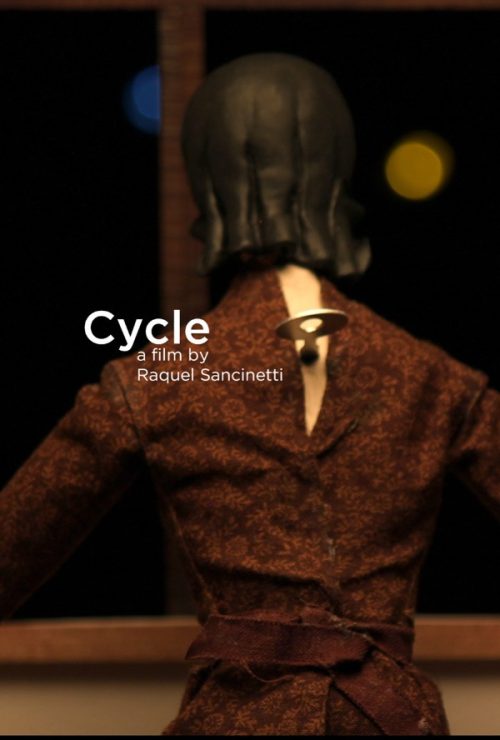
Cycle

Raquel Sancinetti
A man and a woman surrounded by the overwhelming noise of electronics and consumerism. A portrait of loneliness in modern times.
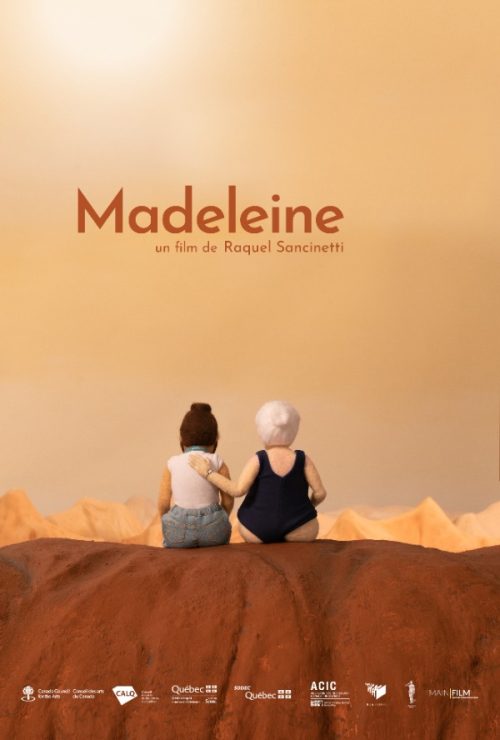
Madeleine
Raquel Sancinetti
Every week, Raquel (41), a Brazilian immigrant, visits her friend Madeleine (107) in her retirement home in Montreal and tries to convince her to get out of the house. The senior woman refuses: she has nothing else to do outside. Raquel doesn’t give up and finds a way to bring Madeleine with her on a road trip to the sea. The result is a journey that plays with reality and fiction and brings a reflection on life, death and the certainty that there is always something to learn along the way.

Classé XXX
Lawrence Côté-Collins
Classé XXX (Rated XXX) goes behind the scenes of porn film shoots in Quebec. Who are the actresses, actors, directors, and producers who make a living from the commercialization of sex? What relationships do they have with their families and other loved ones? Are they able to make a living from their art? The series reveals the personal challenges that come with the marginality of their profession.
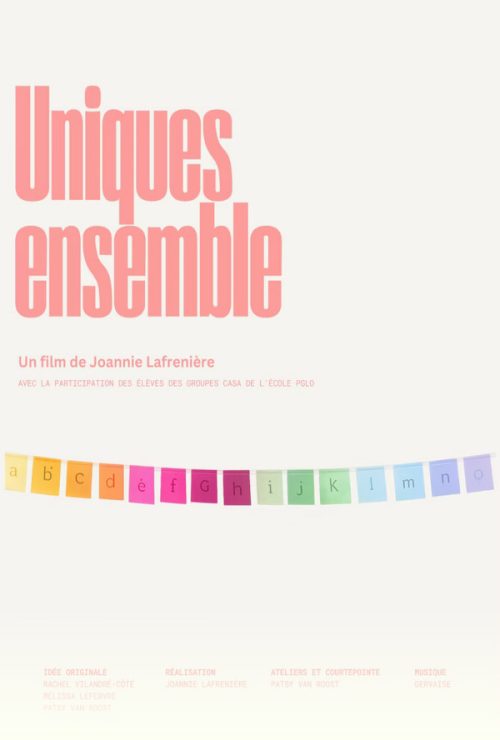
Uniques ensemble
Joannie Lafrenière
To mark Autism Awareness Month (April), Mélissa Lefebvre, Patsy Van Roost, and the bright students of the CASA (Adapted Classrooms for the Autism Spectrum) groups at the PGLO – Paul-Gérin-Lajoie-d’Outremont school decided to create the Uniques ensemble (Unique Together) project with joy and commitment by designing and making a quilt representing their uniqueness and the dreams they carry in their beautiful hearts. This joint creation is therefore a celebration of their singularity and powerful beauty.
50 ans d’avancées des femmes, de la Commission Bird à #MeToo

Érika Reyburn
In 1970, at a time when Quebec was in turmoil, the Bird Commission on the Status of Women in Canada, created three years earlier, submitted its voluminous report. It contained 167 recommendations urging the government and men to adapt to the new reality of the country’s female citizens, who were thirsty for freedom and wanted to emancipate themselves on several levels. Body, sexuality, speaking out, commitment, education, work, family: everything was changing. After 50 years of progress, where do women in Quebec stand today? Entrepreneur, doctor, engineer, politician: today’s young girls can aspire to all kinds of professions without hesitation. Women are no longer confined to nursing, primary education, or secretarial work, even though they still fill almost all of these traditionally female jobs. What is the secret to encouraging girls to think outside the box? And how can we revalue so-called female professions? 50 years of women’s progress – Commitment 50 years of women’s progress – Free Speech 50 years of women’s progress – Body and Sexuality 50 years of women’s progress – Education 50 years of women’s progress…
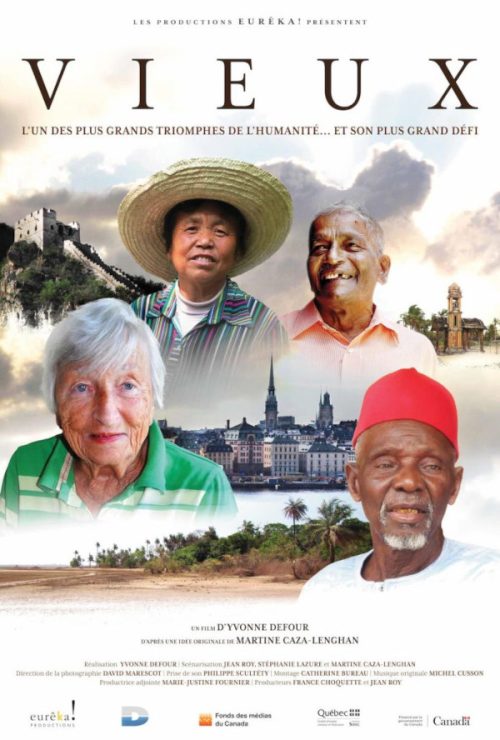
Vieux
Yvonne Defour
We all grow old. That’s a fact. But we don’t all age in the same way. This is obviously due to health, family circumstances, and resources. But it also, and perhaps above all, depends on the country in which we live. Which cultures are inherently favorable to the elderly? And in what ways? While services for seniors are more developed in Western countries, isolation, abuse, and neglect often ruin the lives of older people. Conversely, does multigenerational solidarity in some developing countries make older people happier? In other words, what is it like to be old in different cultures around the world? Vieux (Elderly) follows characters who bear witness to the reality of older people in four countries on four continents. Constructed using alternating montages, this feature film will fuel reflection on aging.
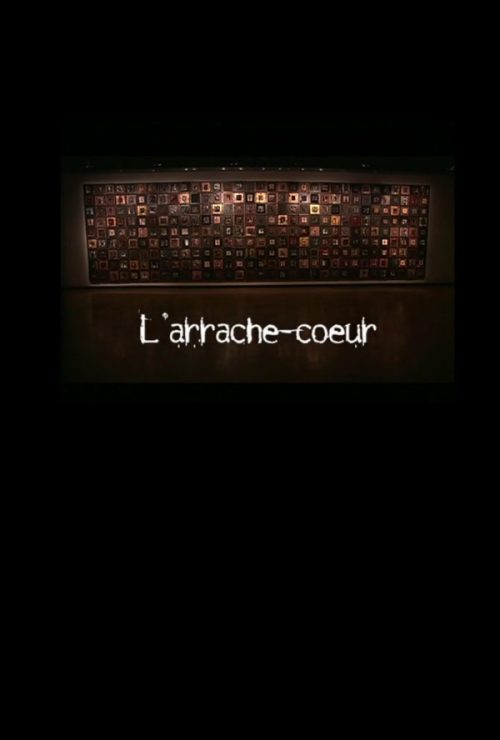
L’arrache-coeur
Yvonne Defour
L’arrache-coeur (The Heartbreaker) is a short film I made for a painter friend, Nathalie Maranda. Her work includes 340 paintings on the theme of female genital mutilation. I chose to make this film because the subject touches on two of my concerns: the defense of human rights and artistic expression.
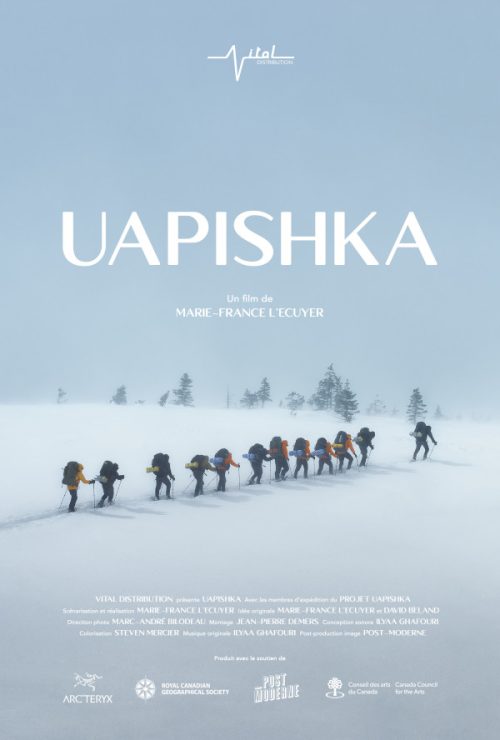
Uapishka
Marie-France L’Ecuyer
North of the 51st parallel, where the dense boreal forest opens onto an arctic islet, the snow-capped peaks of the Uapishka Mountains watch over the Nitassinan of Pessamit. In the heart of winter, a group of Innu and non-Innu adventurers attempt to cross this vast mountain range on snowshoes, completely autonomously. Confronted with the immensity of the territory, the rigors of the northern climate, and the impetuous breath of the tundra, they discover each other in a new way, form friendships, and unite to better chart their course. As the kilometers pass, the adventure reveals a space for encounter, sharing, and reconciliation.
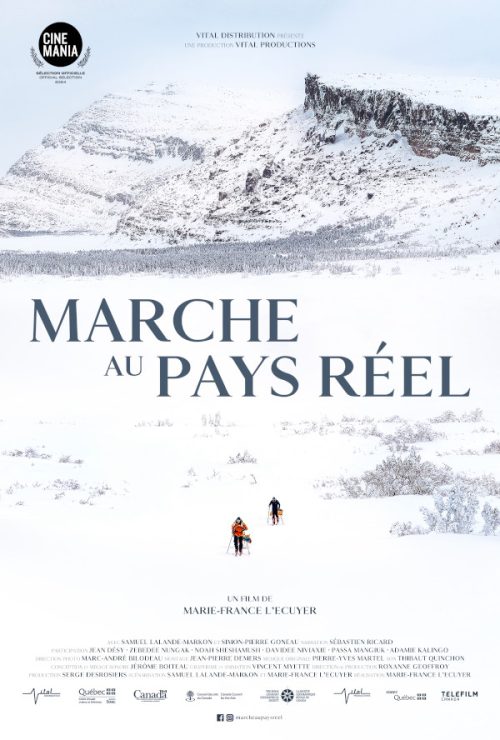
Marche au pays réel
Marie-France L’Ecuyer
Attempting to link southern Québec to its northernmost point by bike and on skis, adventurers Samuel Lalande-Markon and Simon-Pierre Goneau explore not only the vast frozen expanse of the land but also the complex relationship Québecers maintain with it. Their journey first leads them along major northern roads, built to facilitate access to natural resources, then into the wide white stretches of Eeyou Istchee and Nunavik, where they meet members of Cree and Inuit communities. Over the course of their nearly 3,000 km expedition, the country reveals itself in all its splendour and wildness, becoming gradually less abstract, more real.
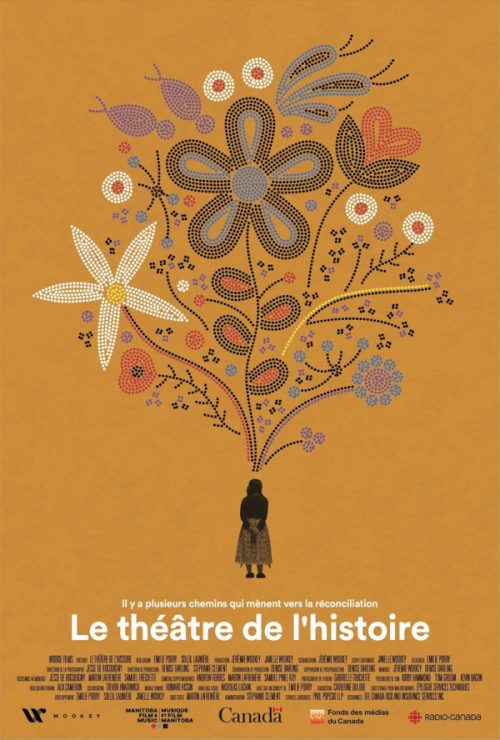
Le théâtre de l’histoire
Émilie Porry
A group of high school students embark on an 8 month long journey to decolonize their understanding of Indigenous history through unconventional means: a theatre workshop. Can a different ‘way in’ lead to a genuinely revised perspective on Reconciliation for the next generation?
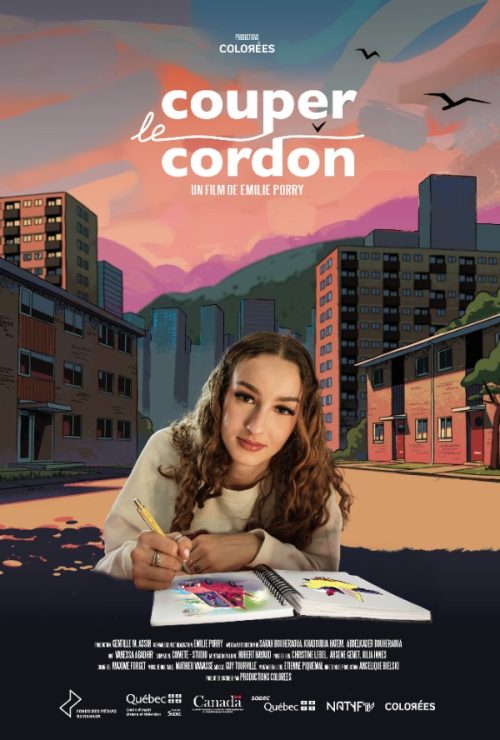
Couper le cordon
Émilie Porry
Sarah is a young Quebec woman on the eve of her 20th birthday. Athletic, disciplined, and ambitious, we follow her reflections on the life choices she must make, torn between family expectations and values and her great need for emancipation. Cutting The Cord deals with universal issues such as the search for identity, the weight of tradition, and the courage to follow one’s own path. But it is also an example of successful integration. Sarah was born here to parents who immigrated to Quebec thirty years ago. She is particularly close to her mother, whose efforts to reconcile her attachment to her traditions of origin with her daughter’s aspirations are evident. Sarah is also fortunate to be surrounded by a circle of childhood friends, thanks to the stability offered by the social housing complex where they live as neighbors, which is designed to be a supportive living environment.
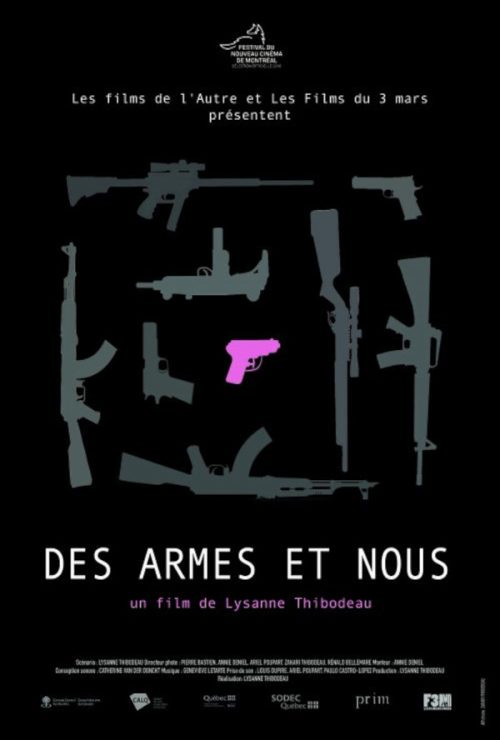
Des armes et nous
Lysanne Thibodeau
The grim routine of suicides, murders, shootings and mass killings in North America is as much in the streets and schools as it is in the home. The subject of firearms is controversial – and the presence of weapons in the home leaves no one indifferent. For some, guns represent a potential threat; for others, it is a legitimate right. However, if firearms arouse a fascination associated with power, force and strength, then surely the possession of one needs to be questioned. A review of our time and the question of arms, this film talks of a controversial, destabilizing and explosively hot topic.